
Data and TV cabling
It is the walls, not your provider.
Inner north houses are double brick, solid plaster and lath. Wi-fi does not travel through any of that well, which is why the back room drops out while the modem sits at the front of the house showing full signal. A cable fixes it permanently.
What we install
Points, runs and the tidy-up.
Most of this work is small, quick and permanent, and a fair amount of it gets done while somebody has the walls open for something else.
Hard-wired data points where the devices actually live. Desk, television, games console, printer. Faster and steadier than wi-fi, and it does not care about brick.
02 Wi-fi access pointsThe better answer for a long house. A cabled access point at the back gives real coverage there, rather than a repeater halving the speed to fake it.
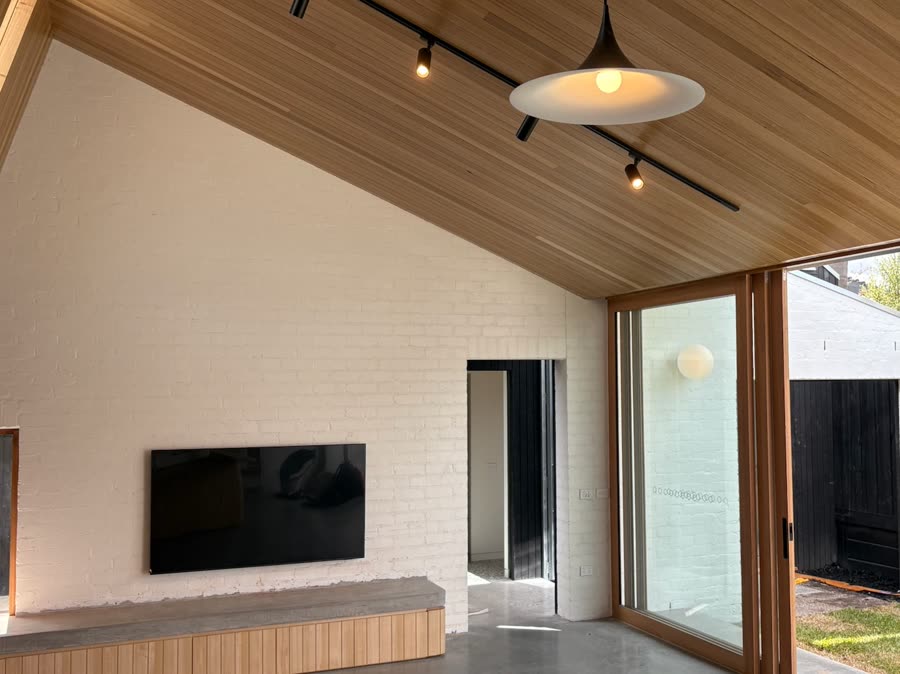
03 TV and antenna pointsNew points, relocated points, and a wall-mounted television with the cabling hidden in the wall instead of hanging below it.
04 Moving the modemConnection points are usually where the builder found it convenient, not where the house needs it. Moving or extending it is often the whole fix.
05 Runs to a studio, shed or unitGetting a proper connection to a building at the back of the block, run underground with the power rather than hoping wi-fi reaches across the yard.
06 Commercial data and commsCabling to workstations, registers and back-of-house in shops, cafes and offices, terminated into a cabinet rather than a knot behind a counter.
07 Camera and intercom cablingCabling and power for cameras, doorbells and intercoms, run properly so the install is not held together by an extension lead in the ceiling.
08 Cabling during a renovationThe cheapest time to do any of this by a wide margin. While the walls are open it is minutes per point instead of a chase and a patch.
Why the back room drops out
Brick, plaster and distance.
A wi-fi signal loses strength through every wall it crosses, and it loses a lot through the ones inner north houses are made of. Double brick, solid plaster over lath, old chimney breasts and the metal in a foil-lined ceiling all take a bite out of it.
Then there is where the modem sits. It is almost always at the front of the house, because that is where the connection came in, which means the signal is starting its journey from the worst possible corner of the building.
Repeaters and mesh kits help a bit and they cost speed doing it, because they are using wi-fi to carry wi-fi. A cable to the far end of the house removes the problem instead of managing it.
- Double brick and party walls
- Solid plaster over timber lath
- Foil-backed insulation in ceilings
- Chimney breasts through the middle
- Modem stuck at the front of the house
- Long, narrow floor plans
- Detached studios and sheds
- Neighbours' networks on the same channels
-
Renovations and maintenance
If you are opening walls anyway, this is the moment to run cable. It costs almost nothing at that stage.
-
Commercial fit-outs
Data, registers and back-of-house cabling as part of a shop, cafe or office fit-out.
Getting it right
A few things worth deciding early.
Cabling is cheap to do well and annoying to redo, so it is worth five minutes of thinking before anyone drills anything.
Cable beats a repeater, but you do not need cable everywhere
The usual sweet spot in a house is two or three well-placed points rather than a point in every room. One at the television, one at a desk, and one feeding an access point at the far end of the house covers most homes completely.
Phones and laptops will still use wi-fi. The difference is that the wi-fi they are using is being broadcast from somewhere sensible instead of struggling through four walls.
Where the run goes
Same problem as any other cable in a period house. Under the floor where the boards allow it, through a cupboard, along a skirting line, or through the roof space where there is one. In a single-storey house with a decent roof space it is usually easy. In a terrace it takes more thought, and we will show you the route before we start.
Businesses: terminate it properly
The difference between a shop that works and a shop that has a problem every second week is nearly always how the cabling was finished. Runs labelled at both ends, terminated into a small cabinet or patch panel, and the equipment somewhere ventilated and out of the way.
It costs a little more on the day and it saves an afternoon of somebody guessing which cable is which, two years later, while customers wait.
Do it during the renovation
Worth repeating because it is the single biggest saving available. Data cabling during a renovation is minutes of work per point. The same points added afterwards mean chasing walls, patching and painting. If there is any chance you will want a hard-wired point in a room, run the cable while the wall is open even if you do not fit the outlet yet.
Television on the wall
A wall-mounted television wants a power point and a data or antenna point behind it, so nothing hangs down the wall. That is a small job on its own and a five minute job during a renovation. Tell us the bracket height and we will set the outlets where the screen will actually cover them.
Reviews
Masaki has a high work ethic and professionalism in his approach to his work and his clients.Darren, Viewbank
Maz was excellent. He was punctual, confirming time and tools to bring. He was very friendly and professional. We will definitely be continuing to hire him for our future electrical needs.Pheobe, Melbourne
Absolutely wonderful job done by Mas, he was efficient, so neat and precise and you can see how much he cares about the work he completes.Gabriella, Fitzroy
Masaki is an extremely reliable electrician, with a very high standard of work, at a reasonable price. I would highly recommend Miki Electrical Group.Chloe, Mill Park
Common questions
Before you ring.
If yours is not here, ask on the phone. It is quicker than typing it out.
Will a cable really fix my wi-fi problem?
If the problem is distance and walls, yes, and permanently. If the problem is the connection into the property itself, no cable in the house will help, and we will tell you that rather than sell you points you do not need.
How many points do I need?
Fewer than most people expect. Two or three well-placed ones usually cover a whole house, especially if one of them feeds an access point at the far end.
Do I need my walls cut open?
Not usually. Most runs go under the floor, through a roof space or through a cupboard. Where a chase is genuinely the only route, you will hear that at the quote.
Can you run cable to a shed or studio out the back?
Yes, and it is best done at the same time as the power for that building, in the same trench.
Can you do it while my renovation is happening?
Yes, and that is by far the cheapest time. Talk to us before the plasterer is booked.
Do you do commercial data cabling?
Yes. Shops, cafes and offices, terminated into a cabinet and labelled at both ends so the next person can work out what is what.
Can you mount a television as well?
We do the outlets behind it and the cabling, set out so the screen hides them. Tell us the bracket height when you book.
Which areas do you cover?
Coburg, Brunswick, Preston, Fitzroy, Northcote and the rest of the inner north, plus commercial cabling across the metro area.
- Electrician Coburg
- Electrician Preston
- Electrician Brunswick
- Electrician Fitzroy
- Electrician Northcote
Solid brick is the common factor across all of these suburbs, which is why this is one of the jobs we get asked about most across the inner north.
Not sure whether you are in range? Ring and ask. It is a thirty second phone call and we will tell you straight either way.
Get in touch
Tell us where it drops out.
Which rooms are bad, where the modem sits, and roughly how the house is laid out. That is usually enough to give you a straight answer on the phone.
- Call or text
- 0492 949 017
- Based in
- Coburg VIC 3058
- Licence
- REC 35681