
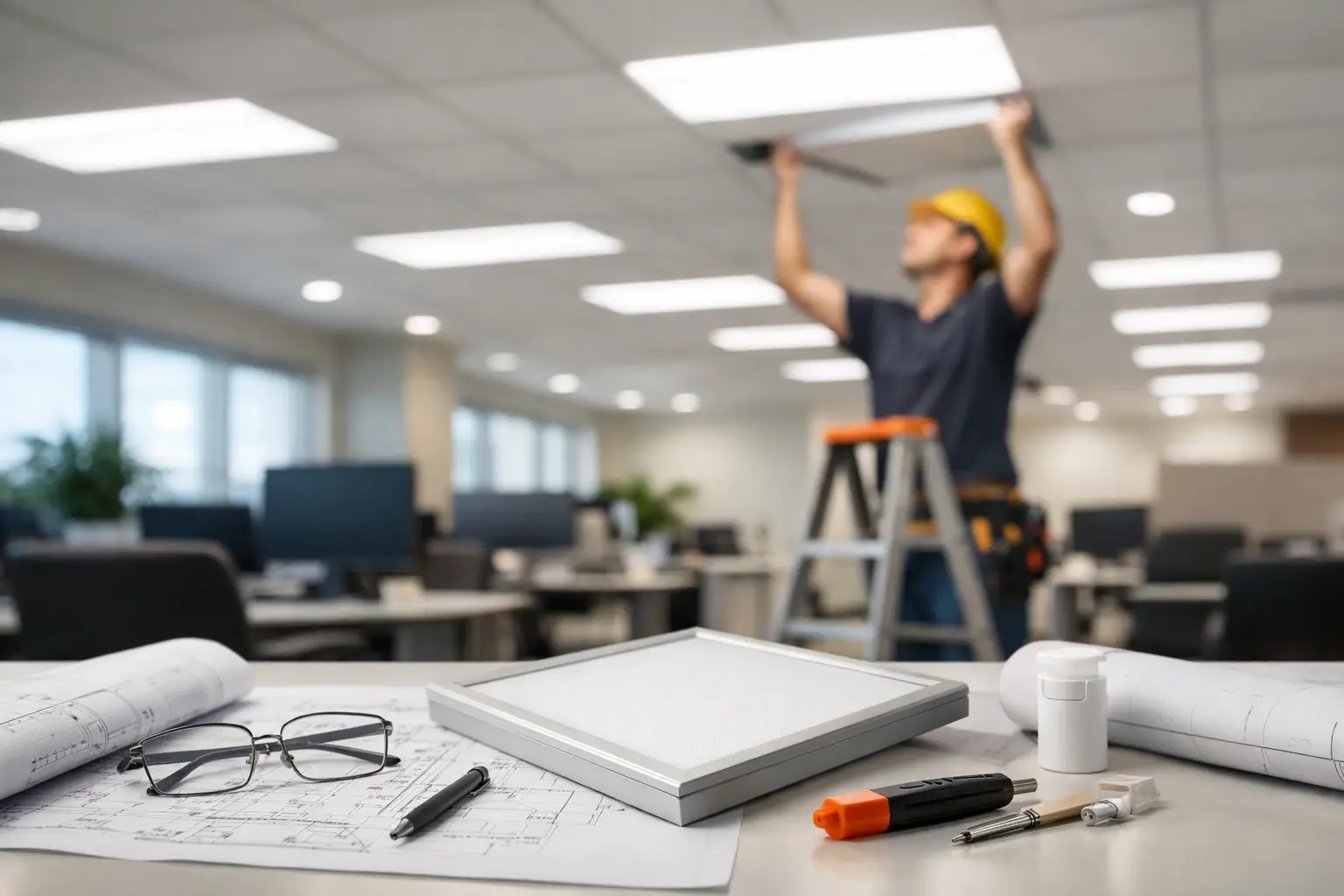
A poorly lit office shows up in small but costly ways: staff squinting at screens, shadowed meeting tables, flickering fittings and lights left on in empty rooms. An LED lighting upgrade can address those issues while reducing energy use and giving the workplace a cleaner, more professional feel. For offices across Coburg, Preston, Brunswick and wider Melbourne, the best result comes from planning the lighting around how people actually use each space.
Start with the office, not the light fitting
Replacing old fluorescent tubes with LED equivalents may be a sensible first step, but it is not always a complete lighting solution. Older offices often have lighting layouts designed around a previous tenancy, partition arrangement or work style. A fitting that once lit a storage area may now sit above a desk, while a meeting room may be relying on the same harsh lighting used in a general open-plan space.
Before selecting fittings, look at the day-to-day function of each area. Reception, workstations, kitchens, corridors, meeting rooms, storage areas and car parks all have different requirements. The aim is not simply to make every room brighter. It is to provide useful light where it is needed, without glare, dark spots or unnecessary power consumption.
A licensed electrician can assess the existing circuit, fittings, switching and condition of the installation. This is particularly worthwhile in older commercial properties in Melbourne's northern suburbs, where ageing wiring, outdated fittings or poorly placed switches can affect the scope of the work.
What a well-planned LED upgrade delivers
LED lighting is known for using less energy than older lighting types, but the benefit is broader than the power bill. Good-quality LED fittings offer longer service life, more consistent light output and less maintenance disruption. That matters in a busy office where changing failed tubes or dealing with intermittent lights interrupts staff and visitors.
Light quality also has a direct effect on comfort. Cool, overly bright fittings can make a space feel clinical, while dim or uneven lighting makes focused tasks harder than they need to be. The right colour temperature and fitting type support comfortable screen work, reading, video calls and face-to-face meetings.
For business owners and property managers, an office LED lighting upgrade also improves the presentation of a tenancy. A bright but balanced reception area, properly lit signage and consistent lighting throughout the workplace all help create a more cared-for impression.
Choose fittings for the work being done
There is no single LED fitting that suits every office. The most effective approach is to match the fitting to the room and the task.
Open-plan work areas
Workstations need even, comfortable illumination that does not create reflections on monitors. LED panels and well-positioned linear fittings are often practical because they spread light evenly across a wider area. Placement matters as much as the fitting itself. If light falls directly into a worker's line of sight or reflects strongly off screens, a brighter fitting may make the problem worse.
Meeting rooms and boardrooms
Meeting spaces need flexible light. Staff may be reading documents one moment and using a screen or video conferencing system the next. Separating lights into switchable zones, or using dimmable fittings where appropriate, gives the room more control without making the setup complicated.
Reception, kitchens and breakout spaces
These areas benefit from lighting that feels welcoming while remaining practical. Reception counters need clear task lighting, kitchens need sufficient light for safe food preparation, and breakout areas may suit a softer feel than the main office. Feature pendants can add character, but they should support the overall lighting plan rather than replace useful general lighting.
Storage rooms, corridors and amenities
These spaces are commonly over-lit or left running all day because the controls are basic. LED battens, downlights or suitable commercial fittings paired with sensors can reduce wasted energy in areas that are used only occasionally. Emergency and exit lighting must be considered separately, as these systems have specific testing and compliance requirements.
Colour temperature, brightness and glare
It is easy to focus on wattage because older fittings were often described that way. With LEDs, the more useful questions are how much light the fitting produces, how the light is distributed and whether it suits the room.
Colour temperature is measured in Kelvin. In many office settings, neutral white light is a practical choice because it feels clear and balanced for daily work. Warmer light can work well in breakout spaces or client lounges, while very cool light may suit some task-based commercial areas but can feel harsh in a standard office.
Glare deserves equal attention. Shiny desks, glass partitions, whiteboards and monitor screens can all bounce light around the room. A quality fitting with suitable diffusion, sensible positioning and the right output can be more comfortable than a cheaper high-output option. This is one area where an on-site assessment is more useful than choosing fittings from a catalogue alone.
Controls can cut wasted power
LEDs reduce consumption, but controls help ensure lights operate only when needed. The right choice depends on the office layout, hours of operation and staff routines.
Occupancy sensors work well in bathrooms, utility rooms, storage spaces and corridors. Daylight sensors may be useful near large windows, where artificial lighting can reduce when natural light is sufficient. Zoned switching lets staff turn on only the section they need, which is often better than lighting an entire floor from one switch.
Smart controls can provide additional scheduling and monitoring, but they are not essential for every small office. A straightforward setup with clearly labelled switches and sensibly divided circuits is often easier for staff to use and maintain. The best system is the one that suits the building and will be used properly.
Check the electrical infrastructure before installation
A lighting upgrade is a good time to inspect the condition of the wider electrical installation. Existing circuits may be suitable for new LED fittings, but problems such as damaged cabling, poor connections, overloaded circuits or an outdated switchboard should not be overlooked.
Commercial electrical work needs to be completed safely and in line with relevant Australian requirements. That includes appropriate protection, compliant wiring methods and correct testing once the installation is complete. If the office is being renovated, the lighting plan should be coordinated with data cabling, air conditioning, security cameras, smoke detection and ceiling works before ceilings are closed or partitions are built.
Plan the work around business hours
The practical challenge of an office LED lighting upgrade is often keeping the workplace operating while the work is completed. A staged installation can reduce disruption, especially in active offices, medical rooms, retail back offices and shared commercial buildings.
Work may be scheduled outside normal hours, completed zone by zone or coordinated with planned refurbishment works. The electrician should identify any required power interruptions in advance, protect work areas and remove old fittings and packaging from site. Clear communication is particularly important where staff are working from home on some days or where access to shared areas needs approval from building management.
It is worth allowing time for final adjustments after installation. Once staff have used the space for a few days, it may become clear that a sensor timing needs changing, a meeting-room circuit should be separated or a workstation needs less direct light.
Avoid the cheapest like-for-like replacement
The lowest upfront quote is not always the best value. Very cheap fittings may have poorer light output, limited warranty support, visible flicker or a shorter working life. They can also make a well-finished office look uneven or dated.
That does not mean every office needs premium architectural lighting. A practical commercial-grade solution, selected for the area and installed correctly, is often the right balance of cost, reliability and appearance. The key is to compare the whole outcome: fitting quality, layout, controls, installation standards, access requirements and likely maintenance over time.
If your office lighting is flickering, uneven, expensive to run or no longer suited to your layout, getting advice before replacing fittings can save rework later. We can assess your workplace, explain practical options in plain English and help organise lighting work that keeps your office comfortable, compliant and ready for the working day. See our commercial fit-outs page for more on how we approach commercial work.
Get in touch
Planning an office lighting upgrade?
Ring for the quickest response. We work around your business hours to keep the office running.
- Call or text
- 0492 949 017
- Based in
- Coburg VIC 3058
- Licence
- REC 35681